
Deep cut
Wednesday, October 28, 2026
Hollybush - the glassmaker's house in Glassboro where Johnson and Kosygin met halfway
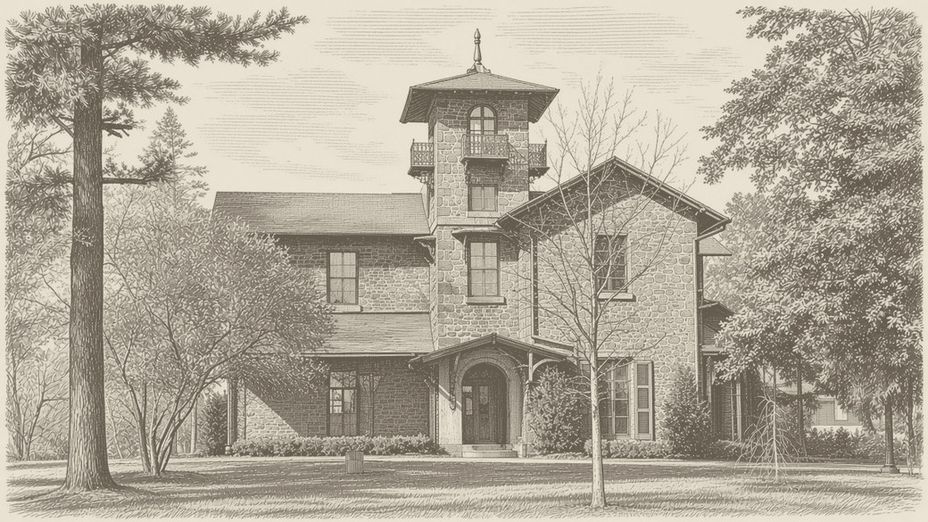
If you've ever cut through Rowan's campus on Whitney Avenue, you've probably clocked the dark stone house with the square tower and figured it was some old administrator's office. I did that for years.
If you've ever cut through Rowan's campus on Whitney Avenue, you've probably clocked the dark stone house with the square tower and figured it was some old administrator's office. I did that for years. Then somebody told me that in June 1967 the president of the United States and the premier of the Soviet Union sat in that house's library and tried to cool off the Cold War, with the whole world waiting outside.
The house is Hollybush. Its story starts long before the Cold War, with a glass family and a town that wanted a college badly enough to pay for the land.
A glassmaker builds Hollybush
Glassboro's glassworks were in the Whitney family's hands by the 1840s. An 1883 history of Gloucester, Salem and Cumberland counties and a 1948 college anniversary booklet both say brothers Thomas H. and Samuel A. Whitney renamed the business Whitney Glass Works in 1842.
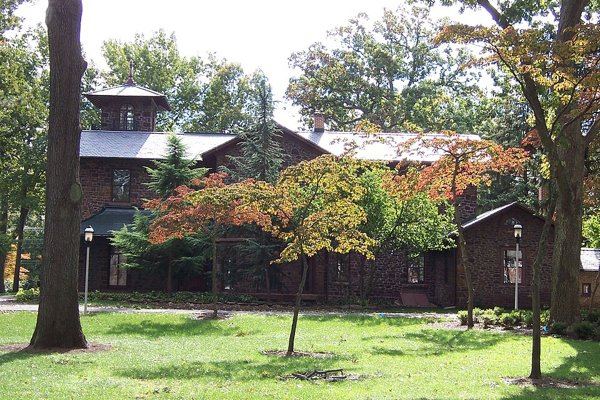
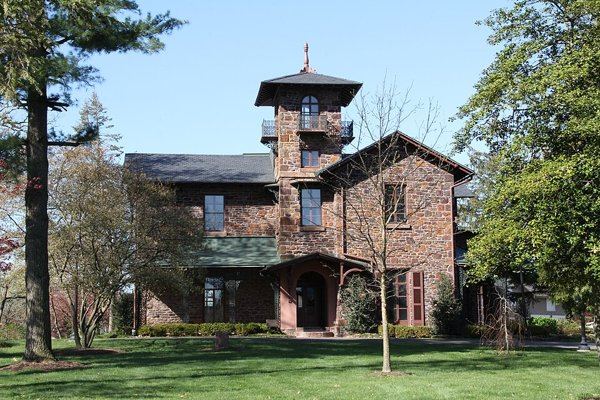
In 1849 Thomas built his house on his estate, which went by Holly Bush. The 1971 National Register nomination for the house says it was designed by the architect John Notman, built of dark brown New Jersey ironstone in the Italian Villa style, two and a half stories with a four-story tower. Look up near the tower's upper doorway and there's a datestone. The nomination records it as "Thomas H. Whitney A.D. 1849," and Rowan's own history describes the same stone with his name and the year.
How Hollybush ended up on a college campus
The Whitney land was eventually split up, and that's where Glassboro's neighbors come in. In 1917, according to Rowan and to Robert Bole's history of the college, "More than Cold Stone," a group of 107 residents raised $7,066 to buy 25 acres of the old Whitney tract, including the house. They offered it to the state for free if New Jersey would put its new teacher-training school in Glassboro.
It worked. Glassboro Normal School opened in 1923, and Hollybush became the school's first women's dormitory, according to both Rowan's mansion history and the college's own 1948 anniversary booklet. Later it became the president's house, and college presidents and their families lived at Hollybush until 1998. The school became Glassboro State College and is now Rowan University.

June 1967, and why Hollybush
In June 1967, right after the Six-Day War, Soviet Premier Alexei Kosygin came to the United States to speak at the United Nations in New York. President Lyndon B. Johnson wanted to meet him. The trouble was where.
Here the sources don't agree, and I'm not going to pick one. Rowan's history says Kosygin didn't want to travel to Washington and Johnson didn't want to meet in New York City. Wikipedia's account of the summit has it the other way around. Both land on the same answer: Glassboro sat roughly halfway between the two cities, so they met in the middle. Rowan credits New Jersey Governor Richard Hughes with suggesting the college.
Sixteen hours to get Hollybush ready
The college and the borough got almost no warning. Rowan, NJ.com and the Courier-Post all put it at 16 hours. At the time, Hollybush was the home of college president Thomas E. Robinson and his family, and it had to become a summit site overnight.
The details are the fun part. Rowan's centennial story and NJ.com both say about a dozen air conditioners went into the house in a hurry, and both say the White House sent china. NJ.com quotes a White House aide who worried that if Kosygin walked into a hot, sticky house, he'd turn around and walk right out. Meanwhile, Rowan says crowds lined the streets of Glassboro to watch history roll down them.
Inside the Hollybush library
Johnson and Kosygin met on Friday, June 23, and again on Sunday, June 25, 1967, in the library at Hollybush. Wikipedia says only four people were in the room at the first meeting, the two leaders and their interpreters, and the Courier-Post also describes the interpreters standing behind them. They talked about the Middle East after the war and the nuclear arms race, and Vietnam came up too.
Nothing got signed. Johnson said so himself at the end, in a line Rowan still quotes: "New agreements are not always reached in a single conversation." What they did get was a better mood between the two countries. Rowan says Johnson called it "the spirit of Hollybush." Most histories, Wikipedia included, call it "the Spirit of Glassboro." Either way it's named for something in this county.
Before he left, Johnson thanked the town directly. "You good people of Glassboro have done your part to help us make this a significant and historic meeting," he said, according to Rowan.

Johnson comes back to Hollybush's campus
A year later, Johnson came back. He gave the commencement address at Glassboro State College on June 4, 1968, according to both Rowan and the American Presidency Project, which keeps the text. Rowan says a plaque on Bunce Hall marks the speech. In it he said, "The world will remember Glassboro, I hope, as a place where understanding between nations was advanced."
A quick myth check on Hollybush
- No treaty was signed at Hollybush. Rowan and Wikipedia agree no agreement came out of it.
- It wasn't three straight days of talks. You'll see "June 23 to 25," but Rowan lists two meetings, on the Friday and the Sunday.
Hollybush today
Rowan says Hollybush now holds artifacts from the summit and hosts special university events, and Wikipedia describes it as a meeting place and museum. The house is on the National Register of Historic Places, under its formal name, Whitney Mansion. Since it's a university event space, check Rowan's Hollybush site before you count on seeing the library. The outside is easy, though. Walk Whitney Avenue and look for the tower.
The short version
Hollybush is a glassmaker's 1849 stone house in Glassboro, saved by 107 neighbors who bought the land for a college. In June 1967 it hosted Lyndon Johnson and Alexei Kosygin for two days of talks in its library, on 16 hours' notice. Nothing got signed, but the mood that came out of it still carries the town's name.